


Cannabinoids, the active ingredients found in the cannabis plant, are a class of chemical compounds that interact with the endocannabinoid system (ECS) in the human body. The evidence that cannabis has been used for medicinal and ritual purposes dates back at least 3,000 years. This is long before humans knew about the Endocannabinoid system.
The Endocannabinoid System
In the 19th century, scientists began isolating and identifying individual cannabis compounds. THC and CBD, the compounds most commonly found in cannabis resin, were the first compounds isolated. Their discoveries led to a deeper understanding of how cannabinoids affect the body and mind.
In 1988, scientists discovered a new part of the central nervous system called the endocannabinoid system. ECS is the largest receptor system and the master regulator of homeostasis in the human body.
“Receptors don’t exist because there’s a plant out there,” said Mechoulam in an interview at the 13th European Congress on Epileptology. “Receptors exist because we, through compounds made in our body, activate them. So we went looking for the endogenous compounds that activate the cannabinoid receptors.”
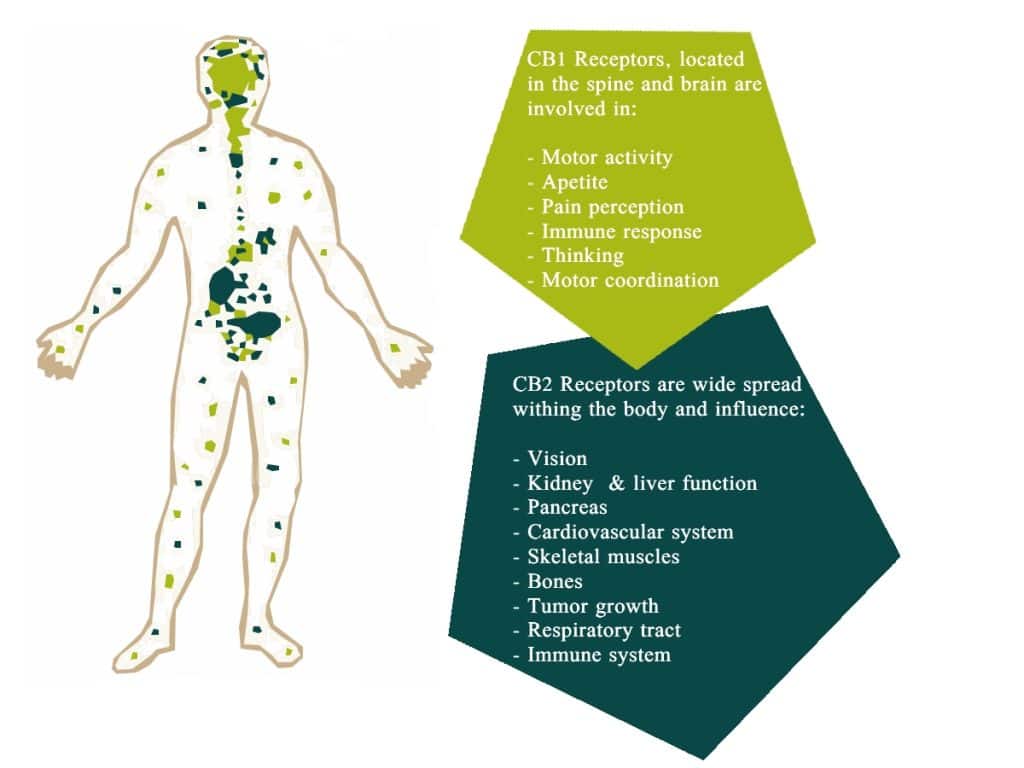
The endocannabinoid system consists of:
- The CB1 and CB2 receptors
- The endocannabinoids which attach to CB1 and CB2 receptors
- The enzymes that form and break down the endocannabinoids
The ECS is a complex cell signaling system found in all mammals. It is involved in a variety of physiological functions such as appetite, pain, mood, sleep, and the response of the immune system. In short, it’s a super important mechanism that makes sure the human body is functioning properly.
Endocannabinoids
Endocannabinoids are a group of naturally occurring compounds that are produced by our body. They interact with our ECS by binding to CB1 and CB2 receptors. Endocannabinoids are produced on demand, when and where needed, and are not stored in large quantities.
Anandamide and 2-arachidonoylglycerol (2-AG) are the two main endocannabinoids. Their full mechanism of action is still unknown, but they appear to be major regulators. But in fact, there are hundreds more. The role of the body’s own cannabinoids is to regulate the release of dopamine, serotonin, and other neurotransmitters.
Cannabinoids
Or phytocannabinoids, are compounds produced by the plant. They are chemically similar to the endocannabinoids produced by the human body and they also mimic their function. The cannabis plant contains more than 100 different phytocannabinoids. Each has its own unique properties and potential therapeutic benefits.
Delta-9-tetrahydrocannabinol (THC) and cannabidiol (CBD) are the best-known phytocannabinoids. THC is the main psychoactive compound in the plant and is responsible for the mind-altering effects of the plant. CBD has no psychoactive effects and is being studied for its potential therapeutic benefits for a wide range of conditions such as pain, anxiety, and epilepsy.
other cannabinoids found in the cannabis plant:
- Δ9– tetrahydrocannabinol (Δ9-THC),
- Δ9-tetrahydrocannabivarin (Δ9-THCV),
- cannabinol (CBN),
- cannabidiol (CBD),
- cannabidivarin (CBDV),
- cannabigerol (CBG),
- cannabichromene (CBC)
Different varieties of cannabis plants contain varying concentrations of phytocannabinoids. Some varieties are bred to be high in THC, high in CBD or have a balance of both. Newer cannabis hybrids are also high in other cannabinoids such as CBG, CBDV, THCV, etc.
Synthetic cannabinoids
Synthetic cannabinoids are chemicals that are not produced by our bodies or the cannabis plant. They are designed in laboratories to mimic the effects of natural cannabinoids. Because they are chemically engineered in a laboratory, their effects can be targeted to achieve the desired effect. Several pharmaceutical companies are attempting to synthesize and patent cannabinoids as prescription drugs. One of these is dronabinol, a synthetic version of THC. It is prescribed to treat nausea and vomiting caused by cancer chemotherapy.
Meanwhile, newly discovered and unregulated synthetic cannabinoids are being exploited by the illicit market. They are often sprayed onto plant material and sold as herbal smoking blends or “fake weed”, “legal weed” or “spice.” They can also cause serious health problems. In some cases, they can be fatal.
Recently, a new trend is on the rise in the United States. Due to a legal loophole, psychoactive cannabinoids are chemically converted from CBD. Cannabinoids such as Delta-8 THC, delta-10 THC, HHC,… come in a variety of forms. They are sold as tinctures, gummies, e-liquids, or sprayed on hemp flowers. Since the production of these cannabinoids is completely unregulated, consumers should take caution!